Text adapted from interviews:
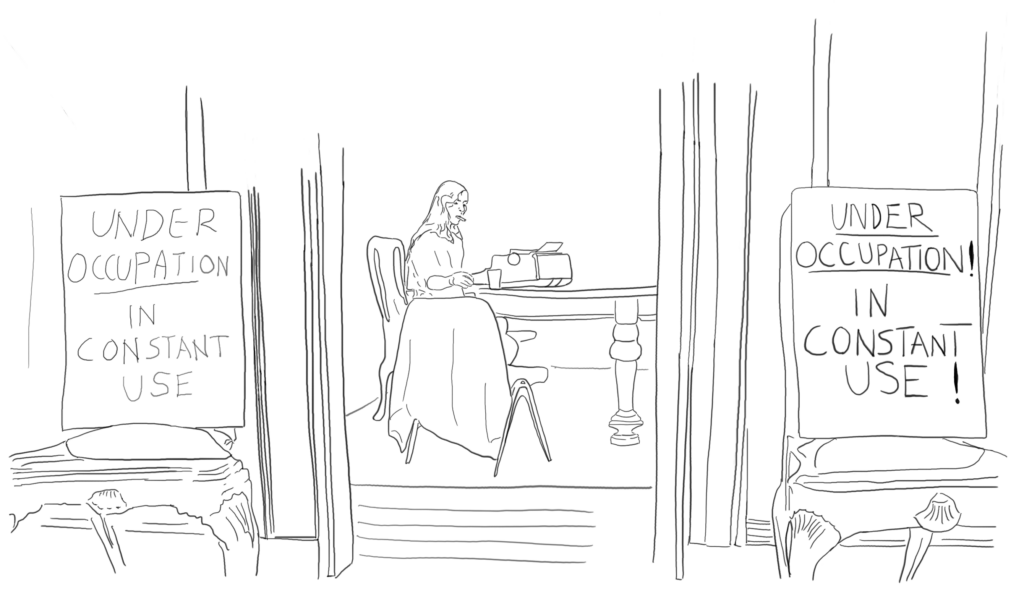
LS – I was working as a caseworker at Camden Committee for Community Relations (CCCR), and I worked in the community work team, doing advice sessions with mainly Bangladeshi families in Camden. A lot of them were living in hotels placed there by Camden Council. We ran these advice sessions on a weekly basis with a member of staff from the Bengali Workers Action Group, which was like a partner organisation. They would come in with their queries which range from; welfare benefits, housing, homelessness, immigration; and we would take these issues away and try to resolve them.
One of the things we found was a lot of homeless Bangladeshi families were in hotels placed by Camden. We began visiting them, finding terrible conditions that they were in. This is over a couple of years that we were beginning to become aware of it.
Then there was the death of a Bangladeshi family on the top floor. It wasn’t exactly a hotel, but it was similar, like a nightly let place, where the smoke alarm and everything else had been disengaged. So nobody knew that there was a fire and the family died there, the husband was working at the time.
When this happened Manesha Huq (Bengali workers Action Group) and I went round to lots of the families that we knew and said let’s go down to the town hall and try and do something about this. Back at the office there was a bit of a discussion about whether this is the right thing to do. Eventually we agreed that we would all go down to the town hall with the families and placards to demonstrate the massive concern. It wasn’t just this family, so many families were also affected by what had happened. So that’s how it kind of started.
EL – I had the grand title of Public Education Officer for the organisation. The role was really about campaigning
or articulating our understanding of the issues for people from the black and minority ethnic communities in Camden. Obviously homelessness was an issue and racial harassment was a big big issue as well.
When we decided what we were going to do, the work began informing our networks. I think that’s one of the
reasons why there was really quite a crowd there, so kind of beginning to mobilise the community itself, and
particularly the families who were in bed and breakfast accommodation owned by the particular landlord,
but also our networks amongst other community activists and organisations.
SS – I was working at CCCR as the housing officer, that job was about ensuring there’s no discrimination in housing; joining with other colleagues in terms of housing campaigns, and monitoring and supporting people around racial harassment on estates.
The fire happened in the night. The following day I remember it was the afternoon, two or three o’clock. I joined everybody else at the town hall so there was quite a crowd outside the town hall at this stage, 40 to 50 families.
LS – We had to help to get them to come because they didn’t have the transport means to get there.

EL – The intention was really to demand some action from the council. What are you going to do about this?
LS – We were invited inside, into the council chamber. They were quite dismissive I think…that was the issue… they didn’t really want to have a discussion. Then it was our colleague Abdul Momen who shouted, ‘RIGHT WE’RE STAYING!’ And that was how it began…
SS – Before shouting that we’re going to stay,
I heard later that he asked the people in Bengali,
‘are you prepared to stay?’ And they said, ‘yes’,
and that’s what he started.
LS – The town hall was much better than the
hotels, you know. We literally took over that first floor. So all the committee rooms and the council chamber, we just took it over.
SU – Can you tell me a little bit about Abdul Momen because he took on a kind of leadership role?
He was quite embedded in the community…
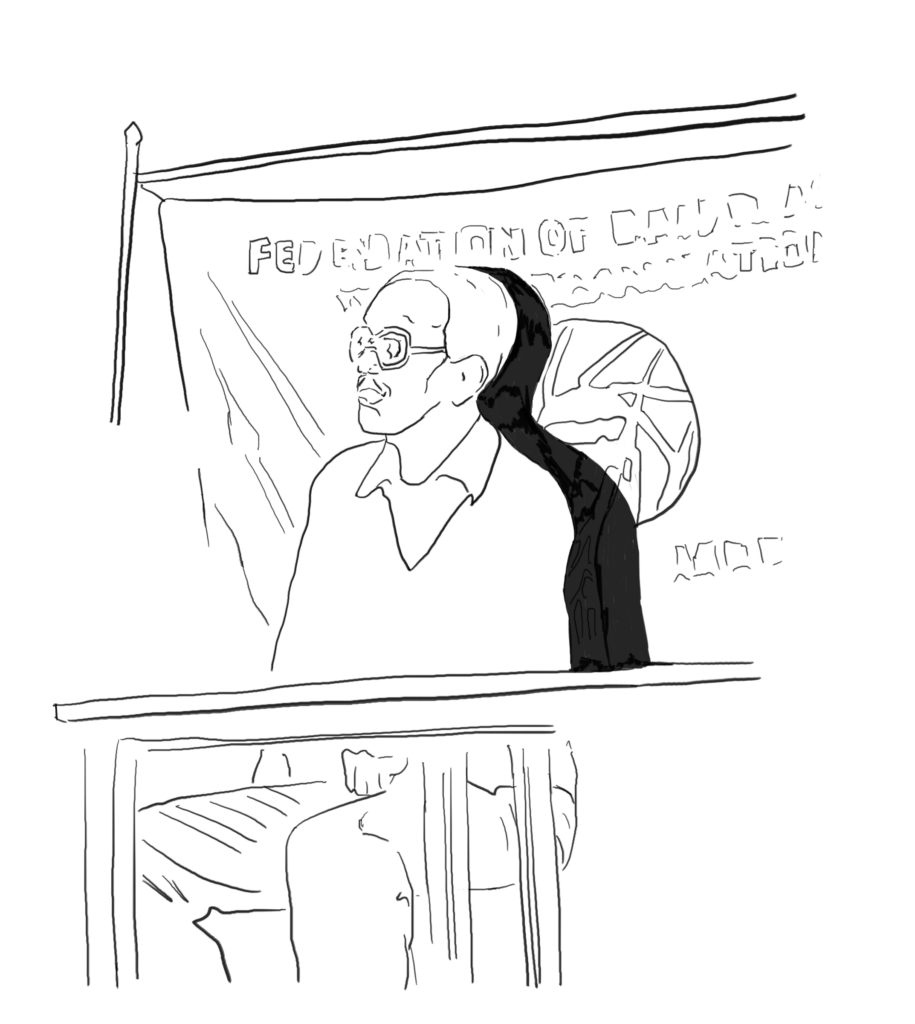
LS – Abdul Momen was the community work team leader, he was my line manager at CCCR. He’d been working for years in the Bangladeshi community in Camden and had done a lot of work around things like setting up a co-operative restaurant to try and create employment for local Bangladeshis. It was called The Last Days of Raj in Drury Lane. He did a lot of campaigning around housing, a lot of work talking to councillors and council staff, taking out cases and trying to get people housed. He was so committed and an absolute workaholic in many ways. Completely dedicated to making the lives of Bangladeshi people in Camden better.
EL – There was a certain number of families, was it 24? These were families who were housed in those hotels,
mothers and fathers and their children, but also the network of community activists as well. Certainly in the early days, there would’ve easily been a hundred people there when we had our daily meetings. The key to its success was they knew Abdul and obviously he communicated in their language. So that was an important part of how we saw our role not as leaders but as facilitators.
LS – A lot of community activists came in from Tower Hamlets to support what was happening.
Then you had all the Bangladeshi led restaurants that were supporting the occupation, bringing in food every day.
EL – There were three white families, single mothers and their children. There were people from housing co-op and people whose interest was homelessness and activity around homelessness. We had a visit at one stage from the Nottingham Black Miners, who came and showed solidarity.
SU – Because the miners’ strike was going on…and there were different parts of the council
that were on strike which I thought was interesting with what’s happening now.
Were they showing solidarity as well, or offering to help?
SS – Some workers were complaining how inconvenienced they were, they were complaining that there were
tea stains in the carpet in the town hall. So a sort of pettiness.
EL – Certainly from housing officers, one of their main concerns was not about the fact that someone had died, that the conditions people were living in were appalling or life threatening, that really didn’t seem to sink in for them. Their main concern was, we don’t want to give the impression of people jumping the queue and we don’t have the accommodation anyway. On the other hand there were other departments, the Race Relations Unit were very supportive, although a bit in the background because they were council officers. The Women’s Unit and Social Services were very supportive. So it was a bit of a mix.
SU – Was there a bit of a clash between the people who were supportive and the council?
EL – I think they were always very circumspect about their support. They wouldn’t say anything publicly, but they were supportive of us and would talk to us about what was going on. I think that conflict of people not quite knowing what position to take, that was amongst the councillors themselves.
The Deputy Leader Kate Allen was very supportive. Phil Turner was the leader of the council and Salman Rusdie’s article in the Guardian mentions that after hearing from one of the families about the circumstances in which they were living, he was kind of quite overwhelmed.
LS – And to see him break down in tears and apologising.
SS – It was through the officers that we first got a list of houses. They were held for repairs as not fit for accommodation. Once we got the list then the demand came up that people should be moved out of bed and breakfast. Soon we went around looking at those houses with the housing officers and they were perfectly fine to live in.
EL – It took quite a few days for that list to emerge though. At first we were being told there is nothing and there was some play made of the fact that, certainly not all of the families were large families, but a proportion of them were and so there is an issue about the difficulty of housing them.
SU – Helal Abbas talks about that…how they tried to divide the families, because you had your list of demands and the council would try to put a wedge in there by saying these people are going to be housed before others. Just to break that togetherness of the families…
EL – I don’t have a great memory of that. I know that the smaller families got rehoused first, quicker. There was one family…because some of the accommodations were next door to each other so we asked why can’t this family be housed in both, which was unheard of at the time, and I can remember one family where we managed to negotiate that.
LS – We weren’t going to stop the occupation without ensuring that everybody in it had a better place to go than back to their hotels. That was what we were trying to avoid, rehouse some and not others, that’s not going to be fair. Everybody involved in the occupation had to be housed before it came to an end, that was the line that we took.
SU – Your collective report highlights the discrimination in housing policy that goes back quite a bit. You talk about how black families in certain areas weren’t given priority for housing because they didn’t want to clear certain areas of slums and give priority points, there’s this history of discrimination in housing policy.
EL – There was always an issue for the families themselves about where they were rehoused because of the levels of harassment that they might face…As far as the allocations policy, there is a whole history of discrimination in housing. I think it’s quite well documented in the private sector. Often what’s not really understood is there’s evidence that estate agents steer families wanting to buy to particular areas and away from other areas. Certainly what happened then was that the cost of housing was also a mechanism through which people end up in particular areas. Of course people say, well, that’s not in itself racist, but the reason that people are on relatively lower earnings is to do with racism in the employment market. So it’s like it’s working together. In the early days, landlords just wouldn’t let to black households or minority households, they just wouldn’t let to us.
LS – They have a different mechanism now. If you’re on benefits, even though they’re not allowed to discriminate on the basis of somebody’s benefits, you have to have a minimum income, so they set the minimum income level very high and exclude people in that way. And you have to have a guarantor and the guarantor has to earn a certain level of funding. I mean, it’s just terrible..
EL – It’s quite likely that the employment market is then working to place black
minority ethnic households in a weaker position.
SS – In terms of private sector discrimination. There were some early Commission for Racial Equality reports
as to how estate agents steered people to particular areas. I don’t remember the names of the reports now…
LS – The Race and Council Housing Hackney report, 1984.
EL – There was also a book by Valerie Karn. Race, Class and State Housing. Which mapped out how local authorities also discriminated, they seemed to place minority ethnic households in areas where they were already concentrated.
SU – What about the properties that they were placed in? Because in your report you say that the families
that were given council housing were given the poorest properties. So that’s definitely discriminatory.
EL – Yeah, because quite often the lowest quality stock is in those areas, so even the council housing,
and we have recent evidence of social housing that’s quite poorly maintained or not maintained at all.
There was really quite a fierce debate at the time really about who should have priority for housing. A lot of the tenants wanted priority to be given to their relatives, their adult children. This wasn’t the succession to the flat or house that you’re occupying, but priority for other housing in the same area, housed close to where their family are essentially.
I think the case that Sabes and myself pursued did seem that there were forms of discrimination, it was actually difficult to pin down. One of the things we realised was that the decisions about not allowing them to be transferred were to do with previous unresolved rent arrears, and some of those arrears were the fault of the way housing benefits work. Then there was racial harassment and the threat of harassment. At that time you could refuse housing, the three offers you were made, just the presence of harassment in particular areas may well have operated to steer people away. They did have a race advisor for housing but he was pretty hopeless in my view.
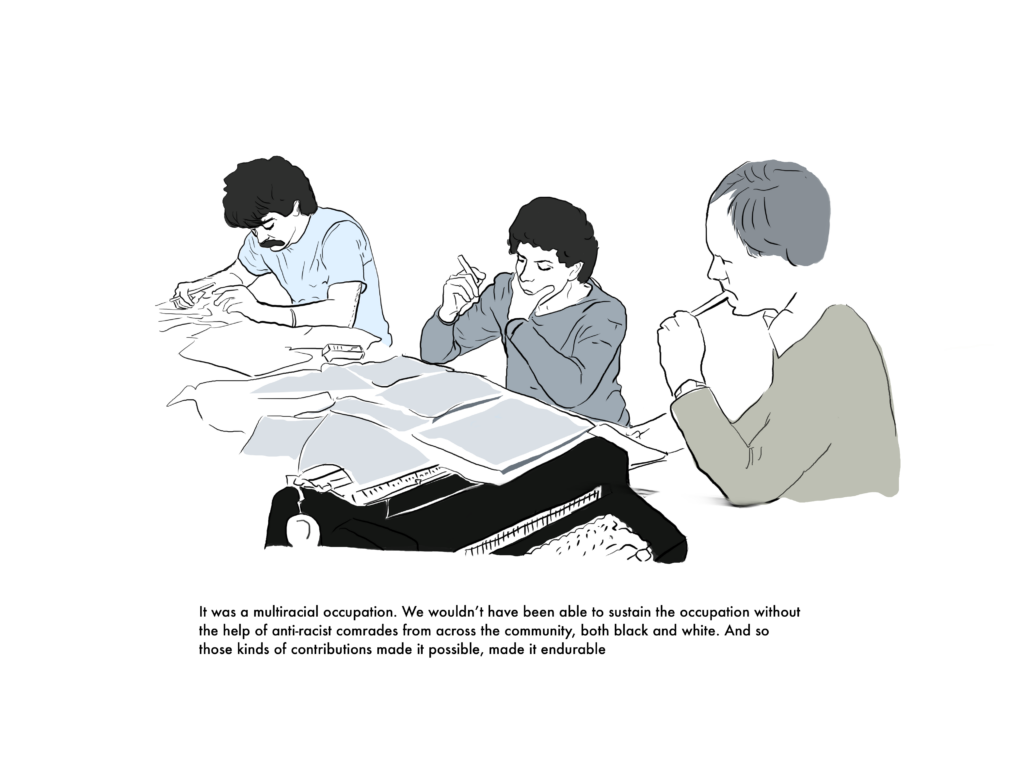
LS – We never went to the office. In fact we brought in equipment like a golfball typewriter and I did a lot of work producing stuff on that, in terms of the strategy meetings written the night before. All the demands and all that
kind of stuff were typed up then.
EL – Myself, Sameen and Abdul would talk a lot about the context and immediacy of what was happening,
and what was going to be the best way to argue things. I think I tended to get thrust forward as a spokesperson.
That was certainly part of my job, but it was very much a collaborative effort though.
SS – Families kept together. Their solidarity. Even after they knew that they were getting a place, they came.
So there was solidarity. They didn’t simply fade away because their demands were met. That is remarkable.
The demonstration was a show of solidarity, publicity, and good-spirited.
EL – The focus of it was homelessness more generally. I think homelessness policies and the way homeless people
were dealt with. I can remember remarking at that meeting that one of the things I’d noticed about the way homelessness was talked about was they were blank faces…
The fact that a large percentage of the homeless households in London were from the black and minority ethnic communities, wasn’t featured, it wasn’t mentioned. Nobody asked the question why are there so many? It was like everyone was featureless and in some respects, even the fact that a high percentage of homeless households are also single mothers again featureless.
LS – When the Labour Party came in ‘97…well over a decade afterwards there was a focus, because the number of homeless households in hotels, in temporary accommodation, whether it was hotels or whatever, had crept up enormously. So there was a lot of work by the government at that point. I was working at Enfield at that point, and
there were just endless meetings with the government, basically giving local authorities targets to reduce the number of households that they had in hotels and in temporary accommodation.
You’d get places like Enfield that had over 3000 families, Newham, and especially in London, it was particularly bad, Tower Hamlets and Camden still. So that was fairly successful. Lots of local authorities reduced their reliance on hotel accommodation. But now it’s creeping up again because of the cost of living crisis, making a lot of people homeless.
The other massive policy change was the Homelessness Reduction Act that came in April 2018, which basically put a lot more duties on the local authorities to resolve homelessness, so prevent it before people became homeless, which has been reasonably successful, I wouldn’t say it’s been wholly so.
SS – In terms of culture, I was thinking of two or three things. One is the way people gel together behind some demands. Their commitment to stay, not moving until demands are met. That conviction came from the people themselves. In fact, they gave that lead to us workers. So that is important.
Sometimes I think it could be Bangladeshi culture, but also it may be coming from their independence struggle.
That spirit. About fighting for it and staying together, so that is an important element as I see it of that culture playing out in this occupation.
From time to time there were cultural events or groups that would come and sing, dance, that sort of thing happened
to lighten up things.
EL – The police were really surprisingly mild, you know, because you could imagine some councils even then saying, well, we just want them out, you know, evict them. And because it was a Labour council, although it wasn’t particularly radical was it? It was kind of middle of the road.
I think there were some radical elements, but it wasn’t particularly remarkable. But that wasn’t something that they chose to do or tried to do. In a sense, they allowed us to occupy. I don’t know what would have happened if the police had come in, because there were a few of them when we were encircling the councillors.
I thought then things might get a bit nasty, but they limited themselves to ensuring that the councillors were allowed to go and then they left. Did they arrest somebody? No, they didn’t arrest anybody…
Already at that stage there were councillors who were in two minds about how to respond. There were certainly some councillors who would have liked us to be evicted. But I think the people who took a different view, that was a larger number. Eventually I think they won other people over to their side, who might be sitting on the fence, or not particularly bothered. I can’t see it happening now, with the kind of government we have, it would be interesting to see.
SS – There was the strike at the time, and there was a conference next door, so they joined us.
EL – We had support from Ken Livingstone as well, which was probably important. He was arguing that hotels
shouldn’t be used for housing families. I mean, the conditions are just not appropriate anyway, which I think was very clear to everyone.
SU – He was supportive of it and I read that he wanted to fund or give some funds, but you said no.
LS – We didn’t want it to be a GLC funded occupation.
SS – That’s important really. I think there were some people in the campaign, the occupation that felt it should be continued and expanded to other places. So there were two opinions, two approaches. Some of us felt that it is local and it’s led by the local community and the others wanted to see bigger potential in it.
EL – I went to Runnymede Trust. I became the head of a research unit, Race & Housing Research Unit at Runnymede because Ken Livingstone had given them money and Sabes came with me. Then I ended up teaching housing studies…
I wasn’t really involved in any other campaigns.
SU – You had to care for yourselves after something like that?
LS – I think from my perspective we probably missed a trick in terms of actually keeping on top of them and making sure they did what they said. Because we were there for a whole month and it was exhausting, it took everything out of us. I don’t think we had any reserves left to kind of do that kind of follow up, making sure it all happened…
EL – I think everybody went off to do other things…I think what Sabes was saying was important, that we argued that the focus should be on the families and making sure that they were adequately safely rehoused. Where other people wanted to make it bigger, broader, homelessness more generally and so on.
LS – Our boss, Chris Adamson, the chief executive of CCCR, said you need to come back to work now and you
shouldn’t be here.. we were saying ‘f off, we’re staying here.’ And then he came in the end and joined in…
SS -The Race and Housing Research Unit, the research projects it funded were different from what the officer’s at GLC anticipated. In a way I see some connection. Those research projects were community based. Run by community organisations, action research projects, law centres, advice centres, all around race and discrimination, gender and race discrimination in housing. So probably, I would just say now that is something positive that we took over and carried on..
EL – That’s absolutely true. The focus of the research was not to have someone piloting in and doing some research and leaving, but to embed a research function in those organisations so that within local communities so that they could do that themselves. Most of the research projects that we funded were of that sort. They came out of community organisations. I think there are limits to that which we didn’t really understand at the time. There were migrant workers, research on them, travellers, domestic violence, which was centred in a women’s organisation.
I was surprised that nothing really happened in terms of stopping the use of hotels. I wasn’t really involved, my career path changed. Homelessness was creeping up again, local authorities were then going back to using hotels. Even if they didn’t have specific policies, when the occupation finished, there was this kind of general feeling that this wasn’t a good idea.
SU – I think Helal said they regulated it more.
LS – Yeah, they did. It’s unlawful for local authorities to keep households in hotels with children for more than six weeks. So that was a key legal change. During the pandemic or lockdown, when I was working in Watford. The hotels opened themselves up because they were obviously losing income because everyone was staying home. So the government worked with the key hotel chains so that they opened up and all the rough sleepers were taken off the streets and put into hotels.