Part 1 Helal & Intro – edited transcript 💾
There were a number of families at that time in Camden who were placed in bed and breakfast accommodation by the Council’s Homeless Persons Unit, and they often went for the cheapest bed and breakfast; placing families in properties which did not meet health and safety requirements; failed fire safety inspections; shared facilities. In one case there were several families living next to each bed and breakfast, but people had to travel to one single unit where they could cook together. Now you can imagine that if you’ve got young children, if you’re a woman and having to share a kitchen in a limited time scale with people that are unknown to you. As a result a number of families were living in properties that nowadays would be deemed unfit for human habitation and one of the bed and breakfast’s caught fire and a Bangladeshi family, a woman with two children died.
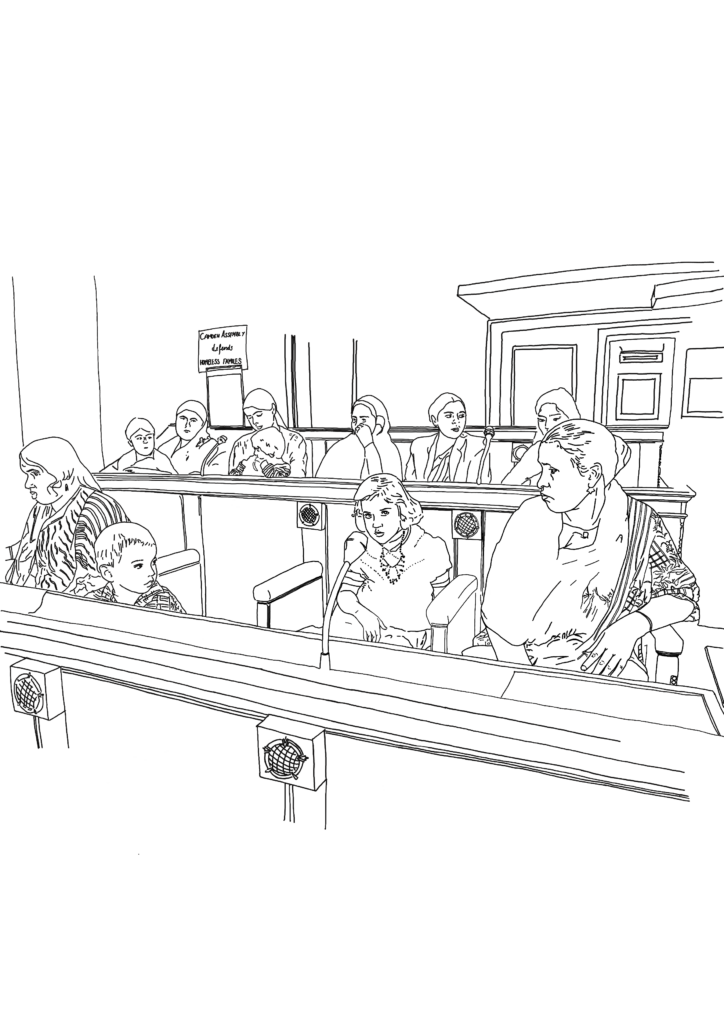
That news took a while to travel. We didn’t have the kind of communication avenues that we have now. A group of families together with some of us went to picket outside Camden Town Hall on Judd Street, just off Euston Road, protesting against the Council’s racist housing policies. It was spontaneous. A small number of people went in and gradually some other people joined. To the credit of two of the councillors they invited the families into the Council Chamber for a dialogue and a discussion which couldn’t have been carried out on the streets. Dialogue continued in the council chamber. There were a number of demands made, a number of accusations made. The councillors became uncooperative and asked the families to leave, the families refused to leave until their demands were met. It turned into an argument and at that point some of those councillors were barricaded in the council chamber. A large number of police stormed in and released those councillors. At no time was there any kind of indication of harm or physical attack on any of those elected councillors. It was never an aggressive occupation.
Families stayed there, mainly women and children. Most of the male partners were restaurant workers who then came and joined after work. I think it went on from there, people came and joined, there were a number of other housing companies and anti-racist groups who quite rightly resourced the campaign, who amplified the voice of those families.
The news actually got out ‘Camden Town Hall has been occupied,’ as a result of the council’s attitude, as a result of the council’s negative approach, as a result of councils failing on their responsibilities. Had they reacted in a humane way, I don’t think the occupation would have lasted that long. I don’t think people would have suffered the kind of conditions in the town hall, although some families quite rightly felt it was safer at the town hall than living in the death trap bed and breakfast.
The occupation wasn’t about Bangladeshi families. It was about a protest against local government racist policies. Happened to be in Camden, happened to be in a borough that claimed to have a progressive race relations policy at the time. What was important is the level of support we had, from lots of people, who never participated in community organising, who never participated in occupations, who probably never took part in any kind of demonstrations. We had over 200 community organisations, across London and beyond, supporting the occupation. The level of publicity, the level of sympathy, the level of donations we had from people who had nothing to do with the Bangladeshi community, who had nothing to do with homeless families. But people actually believed what was happening was unjust, and it was happening because of structural racism that existed.
To galvanise that level of support nowadays would be a challenge. We should be able to do it now because of social media, which is something that we didn’t have in those days. It was coin boxes; people didn’t have mobile phones; you were fortunate if you had a fax machine. Sustaining any kind of occupation for the length of time, about 30 days. I don’t think I can contemplate something like that nowadays.
Most of us who stayed in the occupation lost several stones, being literally on call for 24 hours for a whole month; in terms of safeguarding, ensuring children are collected and fed. When the men come from work, there’s food for them to eat. Reporting back on the activities during the day, planning where the next day’s breakfast, lunch, supper is going to come from. Ensuring it’s an appropriate quality of food, it’s hygienic; ensuring that we were not damaging the council chamber and committee rooms, which have historical importance; and managing a group of children, ensuring that their health and safety are actually protected. Children need play space, to run around in a safe environment and to respect the kind of boundaries that we have.
Abdul Momen was the Senior Community Relations Officer at Camden Committee for Community Relations (CCCR). Liz Smale was the caseworker. So the advice sessions used to run at the centre. We worked as a team. Errol used to be the Education or Policy Officer for Camden Community Race Relations Council. Errol was able to guide us through the policy maze and ensured that we were a match for the well resourced machine of the local council and its communication department.
We had the benefit of Salman Rushdie, who came and visited us on several occasions and wrote on behalf of the occupation. Because of his profile, we were able to get articles published in the Guardian, Independent and a number of other national journals.
There are a number of other people, non Bangladeshi people, who worked together in a comradely manner, but without Abdul Momen’s leadership, support and guidance, I don’t think we’d have achieved as much as we did through the occupation. It was led by people, what we now call lived experience. People with first hand experience of the issues. They knew it was their fight, it was their cause, and they had to lead it. We worked together with families. The families helped each other out. They shared food, they shared the blanket they actually had. They shared childcare responsibilities. Again, it was made possible, I think, because the families were at the forefront of everything we did. There were lots of people who had never taken part in any kind of political actions. I don’t think it was a political action. It was a community action. People were forced to stand up for themselves, stand by people who they saw were mistreated and mistreated because of race and colour.
During the day there used to be administrative tasks, often liaising with journalists, liaising with council officers, undertaking practical tasks, making arrangements from nappies, to blankets, to laundry pick up. On average, we had around 70 to 80 people staying at the town hall.
Families, children of all ages, from infants to adults. It was a big task to ensure in the morning children were provided with the transport to get to the schools they were in and they were not in one school, they were all over. So organising transport was a logistical challenge. We didn’t have a lot of money. We were blessed with a high level of volunteers who offered their services free. Theatre Technics, a Greek theatre, used to run a pensioners club that used to supply sugar, tea, coffee, biscuits. That’s from a community which had nothing to do with the Bangladeshi community. We used to have an Afro-Caribbean Association in Tower Hamlets provide food on a regular basis. We had non Bangladeshis, non-black institutions, Selfridges, they used to give us their delicacies at the end of the day. Children loved cream cakes and jam donuts from Selfridges. You know, those are the kind of tasks that had to be coordinated.
If people needed to go to the GP that had to be arranged. Especially if they lived in a different part of London. At the same time we need to make sure cleansing took place. So we had volunteers who were cleaning the council chamber, cleaning the toilets, we had volunteers running the tea trolley in a chamber where we didn’t have those kinds of catering facilities.
I think we had a number of people who came in on a regular basis to help out with some of the tasks. Solidarity can take place in many different shapes and forms. It doesn’t have to be about giving someone something materialistic. It could just be being in the room with the same person. You could be just sitting next to that person. So we had lots of people passing. We had disabled people who came in wheelchairs and stayed with us. It was a multiracial occupation, although in the main led by Bangladeshi families. So as I’ve said we wouldn’t have been able to sustain the occupation without the help of anti-racist comrades from across the community, both black and white. And so those kinds of contributions made it possible, made it endurable.
Above all I think those families were frightened.. to go back to death traps where they’ve seen a family, children died. For parents to go into an environment they know that’s unsafe, that their children may be harmed. I think it was the responsibility of us who are working with families and children to make sure that we offered them the support, we advocated on their behalf, and we challenged those that were responsible for placing people in those kinds of conditions.
We had I would say support from between 200 to 300 groups. We didn’t have a signing-in process, but there was a health and safety, and safeguarding arrangement in place. There were definitely between 200 – 300 organisations who supported both local, national and perhaps international. I think there were a lot of different levels and types of support. We had people coming in who worked with children, so they were kept entertained, workers who came and took children’s out to Coram’s field, people who came to work with the women. We had musicians who came and played low level music, it wasn’t a concert. There was also the issue about mental health needs. People had to be occupied, to be given some outlets. People had to be engaged in different activities.
The only thing that we couldn’t provide was bathing facilities. I had to go home a couple of times a week for a shower and a change of clothes, and some of the families actually went to any relatives, or other people in and around King’s Cross, who offered people bathing facilities. And I hope I’m not over emphasising it was a real community action. There were people who were living in adequately housed accommodation. They didn’t have to do that. So the solidarity, between people, both in the occupation and the local community made it possible. Being able to offer whatever they can and the level of materials, foods, clothes, toiletries that were donated, we couldn’t have funded. I used to work for a community centre, which was a small community centre with a very limited budget. People who donated weren’t rich, they weren’t corporate companies fulfilling their corporate social responsibilities. They were ordinary people like you and me, who were actually giving a share of their basics, which meant that they really went a little bit without. And I think those are important, because the council couldn’t throw us out, the councillors knew they couldn’t call in the police and evict us. If they did, there would’ve been a major outcry.
It was safe housing. It wasn’t a big demand. It was a simple demand. Yes, housing is always a commodity in demand, but the communities were not new. The local authority knew them. Families were put up in a bed and breakfast place for years, not months but years. And they were put into unsafe places, which as a statutory authority, shouldn’t have done that. If it actually happened today, some of those Councillors probably would’ve been prosecuted as is happening with the Grenfell fire.
We challenged those that were responsible for placing people in those kinds of conditions. Housing policies were never thought of and never took into account the needs of black families, large families, people who wanted to stay together. Rather than accommodating those needs, local authorities sometimes use it as the reason they couldn’t house people, but there was no reason why they couldn’t amend their policies, change their policies, talk to people.
There’s an argument made about the British institution, they want our labour, but not our presence. Happy to have people running the NHS but not be a patient of the NHS. Happy to run the railway services, but you can’t sit in first class. So I think what the occupation did opened up a can of worms about different strands of racism and exposed a lot of people who pretended to be anti-racist.
If a council with progressive race relation policies were found to have acted in a racist manner, what about those that didn’t even have a race relations policy?
Part 2 Helal & Community
I chaired one of the council’s planning committees for about five years. One of the things that I constantly wrestled with was our planning policies. I certainly don’t claim to be an expert in planning policies, but that’s what actually dictates the size of housing you build. Housing policies need to relate to your population. It needs to relate to the size of families within your borough. Quite often working class communities, including white working class communities are still left out of that process. You often get the architects, those that have a passion for protecting Georgian houses. The same thing with Traveller families. You look at the kind of conditions they’re still living in, it’s unacceptable. How many Traveller families and Gypsies are actually consulted on their housing needs? The type of estates they actually want. One of the reasons they live in campsites, designated sites hidden away from the main community, is because our housing estates do not relate to their needs.
Lots of local authorities actually use the excuse of not having large enough properties. That’s a failure on their part of not thinking proactively and not putting a sufficient number of large size units in their planning policies.
You can build 200 one-bedroom units and you can claim we’ve built 200 housing units, but if you build three-four bedroom units, then that immediately is reduced. So I think local authorities play a numbers game. I used to be part of a housing campaign group and housing association. There are funding formulas used for housing costs and the government is guilty of that. The more large units you build, the less of an allowance you get, the more single units, percentage wise you get the higher allowance. So the housing policies in this country, whether centrally or locally, aren’t geared up to meet the needs of families and the Bangladeshi community is a very family orientated community. Our children don’t leave home immediately. That’s perhaps changing now, but still families want to live together and therefore there’s a need for larger housing. You’ve probably seen in your own borough in Camden, people are moving out to the suburbs. People in Camden I know are moving to Watford or Greenford, Ealing, because that’s where larger housing can be found. In the East people are moving, in the early days it was Newham, then it was Redbridge. Now they’re moving far beyond because the inner city dwellings don’t have sufficient larger social housing units. Private sector is not affordable to many of the people that I work or associate with. So I think there is a fundamental, or it’s been designed, to push people out to poorer areas. I think you can use policies to socially engineer demographics and a number of local authorities have done that. In the early eighties, Westminster council did that and were found guilty of selling estates to private developers. Although we have various race relation acts, which I think is much weaker, whereas when we had in the early days the commission for Racial Equality, there was a national body that could challenge government legislation that could bring about pressure on ministers. That’s been taken away. Social engineering is working. I think it works against poor people, working class people and within that category, black people. Bangladeshi families are at the bottom of the ladder and therefore I think end up in worse housing than we should be.
I think there were some liberal councillors who felt guilty. Councillor Phil Turner, leader of the council, I think is a good human being, but he’s surrounded by people who didn’t share some of his policies. There were some people who had the view, well, they’re just getting too much attention. What about the others? Which is a classical divide tactic used. I think the Labour Group was at that time divided. There were some good councillors, to name one, councillor Kate Allen, who wrote about the kind of racism that existed in the Labour Group. People were using issues such as, if we allow this group, then we’ll set precedent. If we allow this group of vulnerable, frightened families with young children, their rightful social housing access, they’ll be jumping queues. They also tried, I think, the divide and rule tactics. Well, if we rehouse these Bangladeshi families, what about the other families? What about families who have been living there for longer? We didn’t demand to be fast tracked. What we demanded was that these families should be housed in safe conditions. Some of the Councillors and their communication machine worked behind the scenes.
The Chair of Housing Julie Fitzgerald, was very aggressive. The chair of the Housing Management Committee, Mike Kirk, resigned in protest. If it was a white family, children perished in a fire, the council would have moved much, much faster to deal with the situation. It’s their failing, it’s their attitude, I think exposed them and their racism. The institution actually failed. They’ve always tried to blame it on a lack of resources. Yes, at that time we had a Tory government led by Margaret Thatcher, but Camden Council was one of the richest councils in the country, certainly one of the richest in London, after places like Westminster and Wandsworth. They certainly had enough reserves. They were subject to capping and government funding, but they had sufficient funding to rehouse those families and they failed and they denied taking responsibility for their failures.
The communication was very clear and transparent and as a result the unity of the families remained solid from day one until the last day. Even though the council at the time tried to divide those families by saying, those in that particular bed and breakfast where the fire occurred will be housed first, others have to wait. The families occupying said ‘no’, we all want to be rehoused. It was important to take that decision and work for the benefit of all the homeless families rather than a small handful of them. It’s a typical colonial strategy which has been used time and time again and probably will continue to be used. But one way we avoided it was by including the need to rehouse ‘all homeless families’ into safe accommodation. The need to move away from the use of bed and breakfast for all homeless families and I think sometimes we have to be broader, bigger and bolder to be inclusive, and that prevented division between homeless families. The Council has a responsibility to homeless families from all communities. I think they tried every trick under the sun, but I think by being inclusive by always having a just approach, I think was our strength.
The trade unions were very supportive, particularly UNISON at the time. Some of the council officers working within the homeless families unit, some council officers working within the housing department were sympathetic. The Women’s Unit of the Equality Unit were actively supporting women. There were threats of disciplinary action against those council officers who cooperated with us. The head of the Equality Unit, Rashid Mufti, was behind particularly the women. The Women’s Unit were definitely under the spotlight of some of the councillors to be disciplined. When the council denied that they didn’t have empty properties we were given information by housing officers. They had more empty units than the number of families who were occupying the town hall. I think by working together again in solidarity, that if you start taking disciplinary action against them, then we’ll be a part of the defence. There shouldn’t be victimisation of workers for speaking out and sharing honest information, which some of the councillors were trying to camouflage.
There’s always more demand than availability of units. All local authorities have housing priorities but at that time Camden was singled out for its failure to place people in temporary accommodation which was safe. They placed them in the cheapest places. The Grenfell Inquiry is now looking at possibly prosecuting officers and members, those involved around redeveloping that tower. Had we had the legislation we have now in 1984, I think some of the Camden councillors and officers probably would have been subject to legal action.
The sad thing is that we haven’t learnt from disasters. I wouldn’t say mistakes, they’re people made disasters, human failings that led to the death of people in unsafe accommodation and that seems to have continued. The occupation was in 1984. We’re talking about a 30 to 40 year difference. The people who died in Grenfell Tower were largely immigrants, black people, working class people, and the reason they died was because the building failed to meet fire regulations and that’s exactly what happened in 1984. I think our institutions have a different attitude to people of colour, people who are poor, than those that are rich.

Part 3 Race & Housing Policies
The two biggest Bangladeshi communities in London at that time were in Tower Hamlets and Camden. The link was natural. There’s a large Bangladeshi community in Tower Hamlets who also were experiencing similar housing issues hoisted upon them by their own local authority, they came and joined us. Many of the people who came to support us were happy to contribute to the needs of those families, and one of the needs was the daily feeding of children and families. I mentioned earlier about breakfast, lunch and supper, and not only from Tower Hamlets and Brick Lane. I remember one particular restaurant whom we knew called Alauddin was a regular contributor. Our insurance policy if no one donated food on the day was Last Days of Raj, in Covent Garden. We could ring them up a couple of hours earlier and say no one is donating food today and they’d supply it. They weren’t big restaurants, they weren’t rich owners. People were running small restaurants. Alauddin used to be a coffee bar. You can imagine in those days the level of income they were generating in the day, but to cook and supply hot food for up to 100 people was quite expensive. But people actually put their hands in their pockets. And one of the things we made sure was that children had nutrition. Families were fed the kind of food that they are used to. Not only Bangladeshi but also other communities. I remember the Afro-Caribbean community organisation in Camden came in one day and we said, you know, it’s getting cold and we need blankets. It wasn’t a rich organisation. They came back with several dozens of blankets, pillows. We had companies donating sleeping bags, shops who brought in a box of tea bags, sugar, cereal. So the link with other family run businesses was similar, because they could feel the pain, they could see the injustice that was hoisted upon our community. But it also resonated with some of the issues people are facing in their own local authorities across all of London. Without the support from many voluntary organisations, many small businesses, we wouldn’t have survived or things would have been different.
The Bangladeshi community woke up after the murder of Altab Ali. The community was under attack before that; the community was subject to racial attacks. It wasn’t just harassment, attacks. There’s a difference between harassment and attacks. It was when someone was murdered and a lack of police action and the only way they responded was when the community took onto the streets. When the community demanded justice, demanded a fair approach to investigations, a fair response from the police force. The same thing happened in Camden. The Bangladeshi families and other black families. Bangladeshi families were a part of the black community in this country, a very small part of it. If you look at housing policies of the early sixties, late fifties in Lambeth, you will find how they have denied access to social housing to black families in Lambeth. Same thing you’ll find in Newham, which has a very high concentration, same in Brent. So I think one of the things the occupation did was open the eyes of people. It forced people to do something about it. They couldn’t live as deniers anymore. They couldn’t use excuses, well we don’t have large enough accommodation. Well put that into your housing building programme, put that into your planning policies.
We used to have daily meetings at midnight. There were a number of people who were working in the catering sector, so they would come home after work and have a debriefing and plan for the following day. And one of the reasons it was a success was because it was family led. Supported by workers such as myself, Abdul Momen and others. I think it took a lot of planning, a lot of sensitive-ness because we are talking about women who don’t readily mix with males from outside the family. We’re also talking about women from a different generation. We had to respect that. We had to plan the activities with them, where they slept, or where they napped in the daytime, so that people didn’t go and walk past or over them, or make a lot of noise. And that took again a lot of organising between families. So it wasn’t the workers, it wasn’t the volunteers. If you are living in a close environment with up to 100 families, there are also tensions. I can’t think of anything specific, but one of the ways that we dealt with or we minimised tensions and risks was through daily meetings where people raised issues. People raised concerns and people could see how decisions had to be made. Being open and transparent made things possible. There wasn’t a leader, it wasn’t politically led, it was community led, it was led by homeless families themselves. So if they wanted to complain, they had to complain against their neighbour or complain about themselves and take responsibility to put it right.
The fire happened due to a lack of proper health and safety measures the landlord had placed in the building. So the fire extinguishers were empty, the fire exits weren’t clearly marked or cleared of obstacles. The emergency lighting wasn’t working. It was an accidental fire but because of the failure in health and safety measures, like in Grenfell, people were unable to escape.
As a result of the occupation: Camden Council stopped using bed and breakfast owned by London Lets. London Lets was the company running a number of bed and breakfast accommodation. The other policy and I think it’s still permanent… families are not even now placed in bed and breakfast. So there were two significant wins for the homeless community. They have to be licensed, which means they have to meet a standard of health and safety requirements, which wasn’t the case at that time. It also means if there are families placed in bed and breakfast, if someone becomes homeless today and they cannot put them into permanent housing immediately, and they need to be put into holding bed and breakfast, there’s a time limit of how long a family in emergency could be placed in bed and breakfast or in hotels. There are homeless families still in our capital. There probably will be, but I think they need to be treated properly and humanely.
All the occupation families were moved from the town hall into permanent housing. There were one or two families who were moved into temporary housing with an offer of permanent housing. The house was being redecorated or had a repair to be done. But all the families who occupied the town hall – the last day we left the town hall was the 11th of December 1984 – had an offer, a physical offer of permanent social housing in their hand.
In those days, people just didn’t have access to communication tools that we have now. I mean, I didn’t have a telephone at home, although I had a proper job, I had a proper income. I think there’s nothing more important and useful than human communication. The networking worked, people responded to the call for help, people responded to the call for unity, and people responded to resources that we needed to sustain an occupation of about a hundred people over a month.
We’re better organised in terms of recording history now than we used to be. We are more resourced. I think we also have more skilled people in our community to tell the story. You need confidence to be able to speak of your disadvantages and impoverishment. There are people who tell us, we shouldn’t talk about bad housing, we shouldn’t talk about squatting, we shouldn’t talk about how appallingly we lived. And I say that was not our fault.
Most of the adult women have probably passed away. There were a small number of young women, women of my generation, my age, who may have moved out. I don’t think there was any kind of process of keeping contact… Some of the activists moved away, taking on different responsibilities…and at that time, women’s movements were not in the forefront of movements.
I think we cannot go forward unless we know where we come from and the battles people fought to make things better for us, and therefore, I think the new generation ought to know things that they have are not easily achieved. They’re achieved because of the sacrifices their elder generation have made, whether it’s in Camden or in Tower Hamlets.
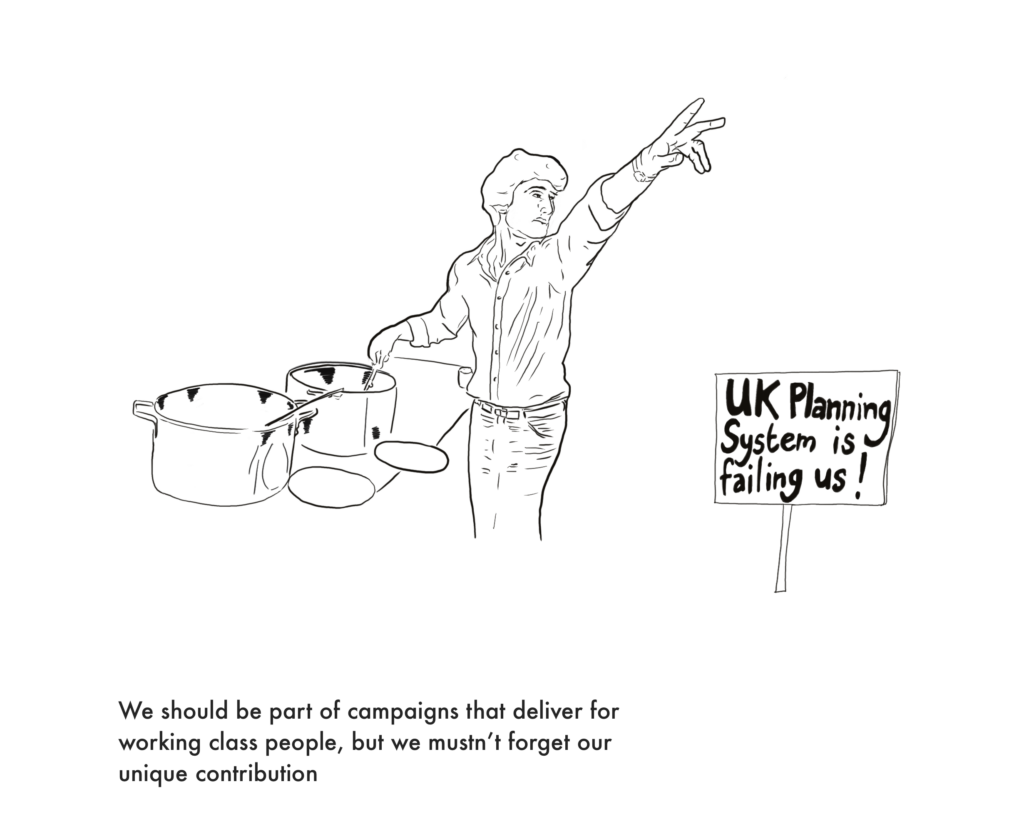
Extinction Rebellion is one example that direct action is happening. I visited their office a couple of months ago. I’m thinking, should I get involved or am I too old for that? Our community is also becoming much more a part of the mainstream. Insulate Britain, the issues affect all of us. The environment affects all of us. We’re becoming mainstream, which is important. We should be part of campaigns that deliver for working class people, but we mustn’t forget our unique contribution. So there are protests taking place, but they’re taking place in a different shape.
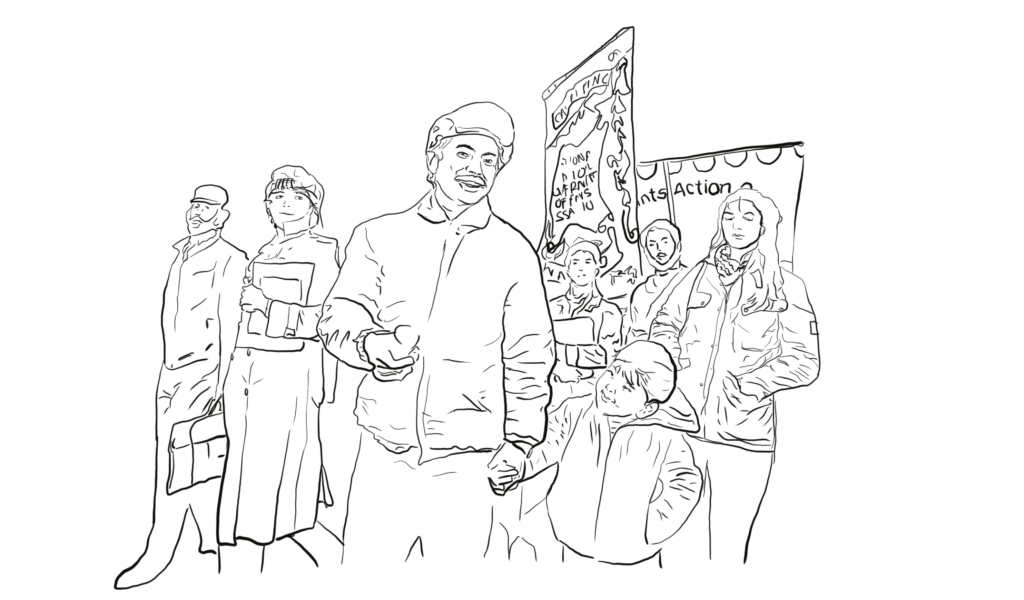
The last day we marched from the town hall to the bed and breakfast establishment where the family died and that was the concluding part of the occupation. There were about 400-500 people on that march. Some of us were relieved that it ended. It ended with success, but physically and mentally it took a toll on all of us. Had it gone over Christmas, whether we could have sustained the momentum and enthusiasm to continue, or people would have given up
Abdul Momen, Liz, myself and the otherswe didn’t have proper sleep, we didn’t have a proper break and sometimes we also didn’t have enough food. It’s something that I don’t think I could contemplate doing now, but I was young, together with lots of other people. I think there was a lot of emotion…people were very passionate and people were angry. If something like that happens now, local authorities will not get away because I think the community has become much more vocal. We now have political representation and spokespeople. In those days the leadership wasn’t there. In Camden we have a Bangladeshi leader, we have several mayors, we have a Bangladeshi MP. We didn’t have a single councillor on the council at that time who could speak for our community, from our community.
He later joined the Labour Party and was elected as one of the first Bangladeshi councillors for the party in 1985 and in 2001 became leader of Tower Hamlets council. He now works for a London wide anti-poverty, equality charity, and is a long time resident of Tower Hamlets.